美人魚答應了。王子用音樂給提示:sol、la 開啟第一關;接著 fa 指向花、mi 指向蜜蜂、re 指向雷電、do 指向蝌蚪、si 指向小河西。當七把鑰匙被一把一把找回,美人魚唱出完整音階 do re mi fa sol la si,暴雨停了,天空變亮,時鐘不再滴答,化為英俊的王子。遠方音樂國的門緩緩打開,兩人共度難關,結合良緣,一起治理音樂國。
Recently, I have been writing fairy tales again. When I was younger, I wrote a book series called Sharing Beauty, A Life of Music. Its theme song, “A Life of Music,” is actually a mermaid fable. On the surface it reads like a children’s story, but underneath it is a map—a map of how a person finds their way back to the world. When someone loses the ability to communicate, or becomes trapped inside an outer shell, what opens the way forward is not always sharper language. Often it begins with a heart willing to connect. And musical intelligence can be one of the ways God rescues education—before words, a system we can feel and follow awakens a living response.
1. Story Summary
The story begins on a bright morning. A mermaid swims up to the surface and hears a tick-tock on the shore. Half-buried in the sand she finds a clock. When she lifts it close to her ear, she discovers that inside the ticking there is music. The music speaks softly: it is the prince of the Music Kingdom.
The prince was born into nobility, but after he refused a witch’s proposal, she placed a curse on him. He can no longer appear in his true form, and he can communicate only through music. He must wait for someone who truly loves him—someone who will hold on to him without letting go, and who will help him recover the seven lost keys of the Music Kingdom so he can return to himself and the kingdom can be restored.
The mermaid agrees. The prince offers musical clues: sol and la open the first gate; then fa points to flowers, mi to bees, re to thunder and lightning, do to tadpoles, and si to the “west side of the stream.” When all seven keys are recovered, the mermaid sings the full scale—do re mi fa sol la si. The storm stops, the sky brightens, the clock no longer ticks, and it transforms into a handsome prince. In the distance, the gates of the Music Kingdom open. They have endured the trials together, and they now rule the kingdom side by side.
2. The Symbolic Meaning of the Fable
This fable is not mainly about magical transformation. It is about how communication begins.
The prince (as a clock) represents people who, through illness, trauma, or difference, cannot express themselves in the “mainstream” way. They may not lack gifts; they may simply be sealed inside a shell, with the channel narrowed.
Speaking only through music reminds us that language is not only words. Language can also be rhythm, pitch, repetition, the body, and system.
The mermaid represents a compassionate person from “another world”—someone who does not depend on translation, but can understand through feeling and structure.
The keys and the scale represent turning confusion into a sequence you can follow—building a sense of direction step by step.
Holding hands represents the starting point of communication: not vocabulary first, but someone willing to come close, to hold, to begin.
The mermaid’s first attempt is simple. She notices the clock has hands, and she has hands too. She holds the hour hand and the minute hand and cries, “Hand in hand!” Two keys fall out, and an arrow is pressed into the sand pointing forward. This detail says something profound: communication often begins not with language, but with willingness—and when willingness appears, direction appears.
Why I deliberately use the English word key
In Chinese, “a key” does not naturally evoke music. In English, key is a richly layered word that opens three worlds at once:
a key (to a door): access—an entrance back into the world
a piano key: voice—press it and sound appears; sound is the beginning of communication
the key of C / key signature: tonality—returning “home” to the tonic, where tension resolves
So the “seven keys” are not merely objects. They are seven life-access points: to re-enter, to sound again, and to return to the tonic—home.
3. Five Scenes as Educational Symbols: Multisensory Awakening, Toward Resolution
What I want to express is not only that music can communicate, but that musical intelligence awakens multiple senses and can open many learning difficulties. Each scene is an educational key.
Flowers (fa): awakening vision and smell Flowers represent an entrance through beauty. When children first see and smell, attention and willingness awaken; learning can approach system through delight.
Bees (mi): activating movement, awakening hearing Bees at work ignite both action and listening. Children imitate with the body and discriminate pitch with the ear. When movement and hearing light up together, learning becomes doable, memorable, and stable.
Thunder (re): awakening—seeing danger, learning to seek protection Thunder is not punishment; it is an alarm. It awakens the child to risk, to boundaries, and to the willingness to pause and seek safety—moving from impulse to self-protection and maturity.
Tadpoles (do): notes themselves—entering musical meaning; tail-wagging as thinking Tadpoles symbolize the notes themselves. A note is not a word; it begins as vibration. The tail’s motion is like a wave—it signals that life still responds and still thinks. Do returns us to the foundation, turning imitation into understanding.
The West Side of the Stream (si): seeking inner steadiness and one’s truth “The west side of the stream” is the place of settling—and the place of solution. In music, the leading tone must resolve into the tonic; only then is the tension completed. Likewise in life: si must move into home—so the self can land, breathe, and become anchored.
4. An Expanded Fable: The Tadpole Kingdom and the “Tail-Wagging Law”
In my writing, tadpoles are not only those who need rescue; they are also the ones who awaken first. In my “Tadpole Kingdom,” a group of ambitious tadpoles found schools, reform education, and study how environmental change shapes life. When pollution begins, tadpoles are the first to know. They are sensitive and easily harmed—yet because of that, they detect danger early. They save themselves, and they try to save the world.
The Tadpole Kingdom’s most famous theory is the “Tail-Wagging Law”:
Good tail, clever tail, a tail can do so much. Wag to the east, sway to the west—the little-pond world is yours to explore. Small pond, big pond—your tail will tell you so. Wag and count, count and wag.
This childlike rhyme actually teaches observation, comparison, counting, and verification—reading the world as an understandable pattern.
And in the opera, the “Great Debate of the Century” between Da-Bao and Fu-Le reveals something else: a community can protect identity through ridicule. “We tadpoles have an ancient tail culture—how could our ancestors be so ugly? Without tails, do tadpoles have a future?” They even drive away the “tailless” one: “You without a tail—leave!” This reminds me that when life is evolving, the old world often blocks change with labels. Yet the way out is often hidden inside the misunderstood transformation.
5. Educational Meaning: How Musical Intelligence Opens Learning Difficulties
Before children learn to read, they learn their mother tongue through instinct and love. In the same way, music can be a language that does not require translation. For children who struggle with literacy, musical intelligence can still offer a path to learn how to live and how to communicate. When words cannot yet hold a child, rhythm, melody, repetition, and system can hold the heart and bring the child back into relationship.
A Life of Music is not only a music textbook. Within its 52 songs are many foundational musical concepts, so children build solfège and pitch sense naturally through singing and play. For example:
In “Where Are Your Hands? Here They Are,” the word hands is sung on sol, so children remember sol through movement and begin to connect it to hand signs.
In “Hand in Hand, Let’s Walk Forward,” every time “hand in hand” appears, the melody is sol–la–sol, strengthening pitch placement and group pulse.
In “Little Bee,” the melody contains three mi; when it arrives in “the garden,” the melody contains three fa, allowing children to recognize scale degrees through story.
In “Little Tadpole,” the name “Duo-Duo” brings out do; in “So Many Clouds,” the word “many” is sung on a high do.
In “Kitty,” phrases like “crossing to the west side” carry si, letting speech-sound and melody form one memory.
And the theme song “A Life of Music” gathers everything: it hides solfège inside lyrics and images, so children build a complete inner map of the scale—little by little, in everyday life.
6. Two Children’s Testimonies: Not Forced Obedience, but Voluntary Commitment
In my life I have met many people who, through illness or misfortune, lose the ability to communicate and are labeled as “strange” or “broken.” Yet they still carry gifted instincts, hidden in some corner of cognition. If someone understands the right entry point, they can gently guide that person toward communication. And communication is often the beginning of healing.
I have also witnessed this fable in two autistic children.
One child has exceptionally strong motor intelligence and learns quickly, but he dislikes being corrected and rarely practices at home. Parents and teachers often feel helpless because he has his own opinions. Yet because he deeply loves his teacher, he is willing to listen. The teacher does not force him, but waits until he is willing to practice—and allows him to decide for himself that he wants to change. One day, after thinking quietly, he said, “Starting today, I will practice.” He even proposed his own solution: locking away what distracts him and reshaping his daily rhythm so he can keep his promise. At the end he asked for a hug as a seal—his commitment. In that moment I understood: real change is not pushed into a child; it is born inside safety.
The younger brother’s path was longer. His teacher spent a full year accompanying and waiting until he was willing to keep an agreement in order to remain in the classroom. The agreement became three kinds of respect:
Respect the teacher: when his behavior becomes a problem and the teacher stops him, he must stop—because the teacher is the teacher.
Respect himself: do what needs to be done; if everyone participates, he participates too; do not do actions that would make him feel ashamed if others knew.
Respect the environment: he has great freedom to use the space for joy, but if his joy will damage the environment, he must stop.
This is not suppression. It is leading a child to the “west side of the stream”—a place where he can settle, breathe, and grow, where freedom and responsibility can both stand.
Conclusion
In this fable, the keys are not metal. The keys are pathways: a heart willing to hold hands, a system that can be felt, learning awakened through multiple senses, and finally the musical truth of resolution—the leading tone returning to the tonic. When someone understands that language, communication begins. And when communication begins, the world becomes larger. A life of music becomes, quite literally, a life-giving key.
英文版 Story 1: The Little Frog Looks for a Wife (English version, with the same repeating pattern)
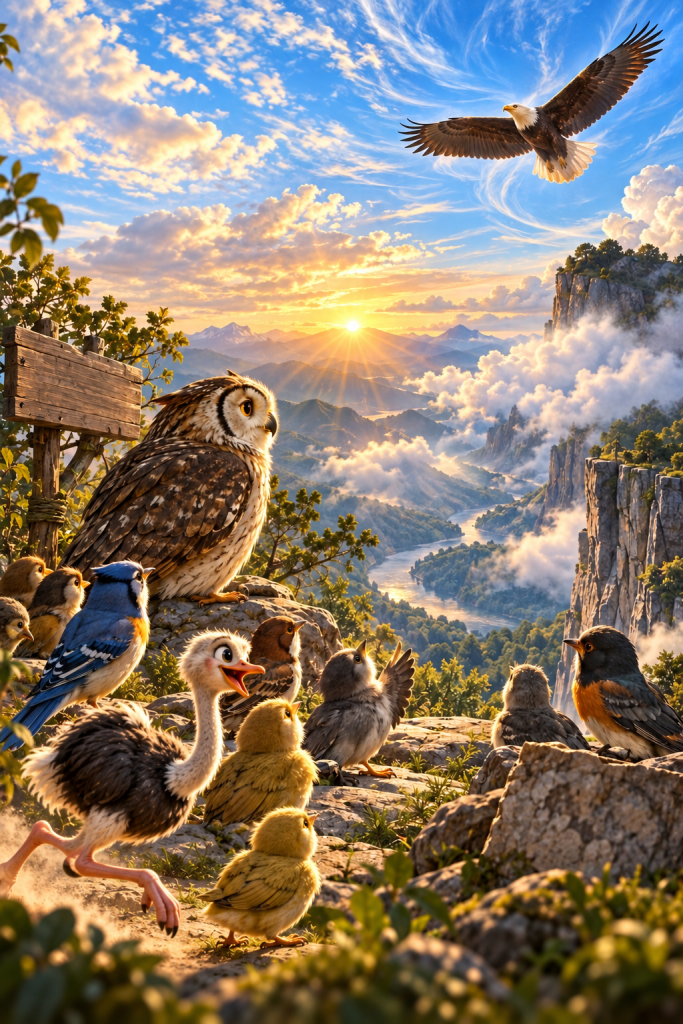
Picture 1|Owl Gives the Clue
Narrator Once upon a time, there was a little frog. His best friend was an owl. But recently the owl got married. He became very busy and had no time to play.
Little Frog “I want a wife too. Who should I look for?”
Owl “Someone who sounds the same.”
Narrator / Little Frog (thinking) “Sounds the same? What does that mean?”
Picture 2|In the Backyard: The Cat
Narrator The little frog hopped, hop-hop-hop, to the backyard and saw a cat.
Little Frog “I am a frog. What are you?”
Cat “I am a cat.”
Little Frog (thinking) “Cat AA (sound brick), Frog AA (sound brick)… they sound the same!”
Little Frog “Will you marry me?”
Cat “I am a cat. You are a frog. We are not the same. We don’t match.”
Picture 3|At the School Gate: The Spider
Narrator The little frog hopped, hop-hop-hop, to the school gate by the traffic light and saw a spider.
Little Frog “I am a frog. What are you?”
Spider “I am a spider.”
Little Frog (thinking) “Spider AA (sound brick), Frog AA (sound brick)… they sound the same!”
Little Frog “Will you marry me?”
Spider “I am a spider. You are a frog. We are not the same. We don’t match.”
Picture 4|Under the Big Tree: The Myna Bird
Narrator The little frog hopped, hop-hop-hop, to the big tree and saw a myna bird on a branch.
Little Frog “I am a frog. What are you?”
Myna Bird “I am a myna bird.”
Little Frog (thinking) “Myna AA (sound brick), Frog AA (sound brick)… they sound the same!”
Little Frog “Will you marry me?”
Myna Bird “I am a myna bird. You are a frog. We are not the same. We don’t match.”
Picture 5|By the Stream: The Turtle
Narrator The little frog hopped, hop-hop-hop, to the stream and saw a turtle by the water.
Little Frog “I am a frog. What are you?”
Turtle “I am a turtle.”
Little Frog (thinking) “Turtle AA (sound brick), Frog AA (sound brick)… they sound the same!”
Little Frog “Will you marry me?”
Turtle “I am a turtle. You are a frog. We are not the same. We don’t match.”
Picture 6|In the Vegetable Garden: The Frog Girl
Narrator The little frog hopped, hop-hop-hop, to the vegetable garden and saw a frog girl.
Little Frog “I am a frog. What are you?”
Frog Girl “I am a frog girl.”
Little Frog (thinking) “Frog Girl AA (sound brick), Frog AA (sound brick)… they sound the same!”
Little Frog “Will you marry me?”
Little Frog (suddenly worried) “No, no… The animals I met before sounded the same, but they all said we were not the same. I think you will say it too: ‘You are not the same as me. I can’t marry you.’ Right?”
Frog Girl “I am a frog, and you are a frog. We are the same. I will marry you.”
Narrator (ending) At last, the little frog understood: It is not “sounding the same.” It is being the same kind.
Teacher: Sim Life. Student: What are we playing? Teacher: Today we will build a story map and perform the story. Student: What is the qualification? Teacher: Make the map, follow the map, then verify the map.
Teacher: Sim Life. Student: What are we playing? Teacher: Today we run a full-moon gift company. Student: What is the qualification? Teacher: Make, pack, deliver, receive return gifts, and verify the blessing cycle.
5) 活動流程(做 → 送 → 回賀 → 驗證)
做紅蛋(衛生規則:洗手、手套;混齡協作)
油飯到位(可協作外部製作;孩子負責分裝與標籤)
裝盒:油飯+紅蛋+祝福卡
配送:送到指定親友/班級/老師(可校園內模擬或真送)
回賀:收禮者回賀「白米+石頭+一句吉祥話」
回到公司:統一收回回賀,完成「一圈」
6) 三種程度 Levels(混齡同堂)
Level 1|做得到(Action)
會裝盒、會送出、會收回
Level 2|說得出(Blessing Language)
會說祝福/致謝/回賀吉祥話(見下方句型)
Level 3|驗證得了(Verify the cycle)
會用紀錄表驗證:送達率、回賀率、祝福句是否完成
7) 祝福語句(CN/EN)
送禮
CN:我們送滿月油飯和紅蛋,祝福小娃娃健康長大。
EN:We bring full-moon rice and red eggs. Bless the baby to grow healthy.
致謝
CN:謝謝你們的祝福,我們收到了。
EN:Thank you for your blessing. We received it.
回賀(白米+石頭+吉祥話)
CN:我們回賀白米壓石頭,祝你將來甜蜜又結實。
EN:We return rice with a stone on top—may your future be sweet and strong.
8) Encoding(兩張表單:讓愛可回讀、可追蹤)
A. 送禮紀錄表 Delivery Log
收禮人/送出者/禮盒編號/是否送達/是否說祝福句/簽收
B. 回賀驗證表 Return Verification
回賀人/收回者/白米+石頭/吉祥話/是否回到公司
9) Recognition(公開完成一圈)
每組分享:今天最感動的一次祝福/最有力量的一句吉祥話
全班齊讀一句結語:
CN:我們驗證送達與回賀,所以祝福完成了一圈。
EN:We verified delivery and return, so the blessing cycle is complete.
Teacher: Sim Life. Student: What are we playing? Teacher: Today we run a housing company and join an expo. Student: What is the qualification? Teacher: Make promises customers can verify. Build, exhibit, and sell.
Teacher: Sim Life. Student: What are we playing? Teacher: Today we run a tile shop. Student: What is the qualification? Teacher: Count the side in units, verify it is a square, and count inside squares as the price. (中文補一句)今天我們用「驗證」來說話。
5) Teacher 示範(一次做完三步)
黑板固定句(全課通用)
邊用 units,裡面用 square units。
先數(units)→ 再驗證(square)→ 再數裡面(square units)。
示範流程:
在方格紙上畫出正方形 → 剪下來(磁磚誕生)
數一條邊:___ units
驗證四邊:Top/Bottom/Left/Right 是否相等 → 是 square
數裡面格數:___ square units → 價格 = ___
6) 三種程度 Levels(混齡同堂)
Level 1|數邊長(units)
任務:選一條邊,從角開始數格子
句型:這一邊有 ___ units。
Level 2|驗證正方形(Verification → square)
任務:四邊都數,做出結論
打勾驗證:□Top □Bottom □Left □Right
句型:我驗證四邊相等,所以它是 square。
Level 3|數面積(square units)
任務:一排一排數裡面格子(不必用平方)
句型:裡面有 ___ 格,所以面積是 ___ square units,價格 ___。
7) Write First(今天的寫:先畫再剪)
3–4 歲:老師畫框,孩子剪
5–6 歲:孩子自己畫框再剪
7–8 歲:加寫標籤:side length / square / square units
8) Encoding(上牆:價目牆)
每位孩子貼三行(固定格式)
side length = ___ units
verified: □ square
area = ___ square units → price = ___
9) Recognition(小型商演:報價)
Customer: How much is it? Owner: The area is ___ square units, so the price is ___.